









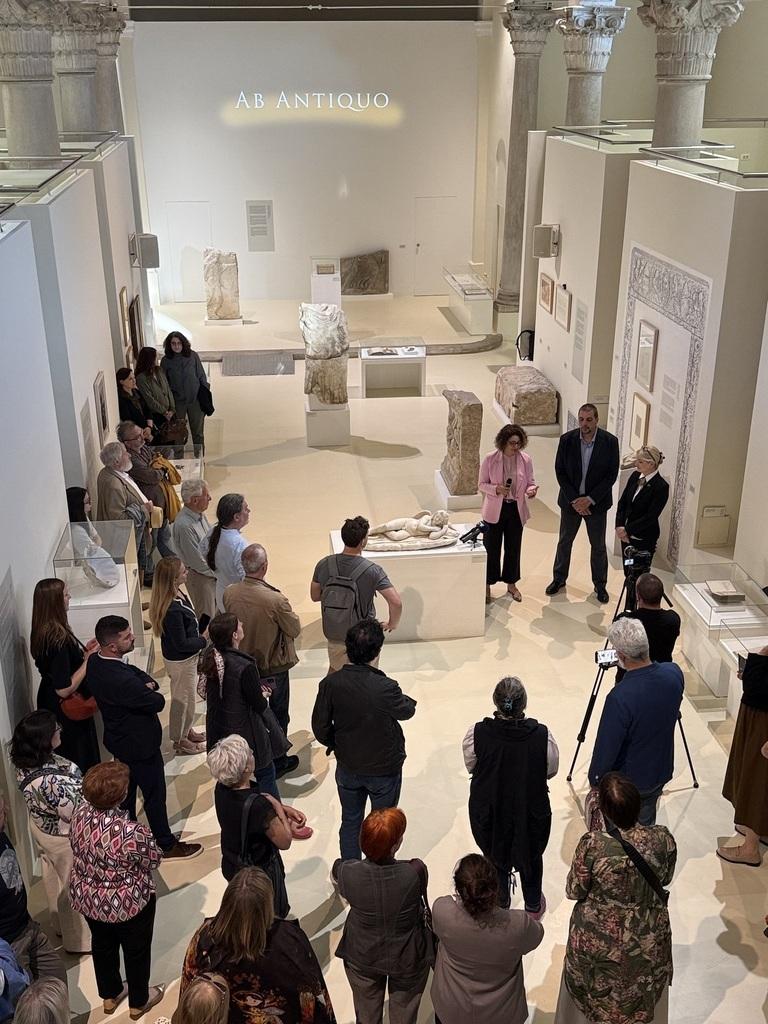
AB ANTIQUO Exhibition
- AB ANTIQUO offers a unique perspective on the influence of the ancient heritage of the Eastern Adriatic coast on European Renaissance and Baroque architecture -
The exhibition AB ANTIQUO - European Architectural Culture and the Antiquities of the Eastern Adriatic explores the regional and European reception of the ancient heritage of the Eastern Adriatic through a remarkable selection of original drawings, prints, rare books, and Renaissance and Baroque architectural treatises.
It reveals how the Roman remains of Pula, Zadar, Salona, and Split - strategically positioned along the trade routes to the Levant - inspired generations of humanists, artists, and architects throughout Europe. While the ancient monuments of Pula achieved international glory at an early date through architectural treatises, drawings, and engravings circulating from Italy to Great Britain, the heritage of Split and other Dalmatian sites resonated deeply within humanist and artistic circles, reaching a broad European audience through the lavishly illustrated publications of the 18th century.
Among the exhibition's highlights are rare historical drawings by Renaissance and Baroque architects active along the Eastern Adriatic, on loan from the Museum of Hvar Heritage and the Abbey Collection in Korčula. Also on display are exceptional copies of architectural treatises annotated by builders and architects, preserved in Croatian collections ranging from the National and University Library in Zagreb to the Scientific Libraries of Dubrovnik and Zadar, and the University Library in Rijeka.
The exhibition features drawings by artists from Raphael's circle and the da Sangallo family, works by Johann Bernhard Fischer von Erlach, engravings by Giovanni Battista Piranesi, as well as rare architectural treatises and historic representations of ancient sites along the Eastern Adriatic coast.
Spanning four centuries of fascination with the antiquities of the Eastern Adriatic, AB ANTIQUO offers visitors a fresh perspective on the Adriatic's pivotal role in the development of European art and architecture.
Admission: Free of charge
Opening hours: 09.00 - 20.00
Sveta srca Museum-Gallery Venue
Contact: +385 52 353 185, sveta-srca@ami-pula.hr
Location: De Villeov uspon 8, HR-52100 Pula-Pola
»» View on Google maps
Located in the heart of Pula's historic centre, the Church of the Sacred Hearts of Jesus and Mary was built by the Sisters of the Congregation of the Sacred Hearts. The convent was completed in 1899, followed by the construction of the three-aisled church in 1908 in the style of Late Baroque Classicism. The project was initiated by architect Virgilio Volpi and completed by Domenico Malusà. Although a 26-metre bell tower was originally planned, it was never constructed. Today, the desacralised church serves as a museum-gallery venue of the Archaeological Museum of Istria.
Accessibility for people with disabilities
The Sveta srca Gallery is accessible to visitors with reduced mobility.
Both the main ground-floor entrance and the secondary first-floor entrance are equipped with ramps. The venue also features a platform lift, an accessible restroom, an accessible reception desk, and a tactile orientation map.
Please note that tactile exhibition displays, audio guides, sign-language interpretation, and guides in simplified language are not currently available.
For further information regarding exhibition accessibility, please contact: +385 52 351 310, gobic-bravar@ami-pula.hr
